
<ruby><rb><rp><rt>
| Browser |
|
|---|---|
| Type |


The following elements defines a ruby.
<ruby>
<rb>ruby base</rb>
<rp>(</rp>
<rt>ruby text</rt>
<rp>)</rp>
</ruby>
| Element | Explanation |
|---|---|
<ruby></ruby> |
defines a ruby |
<rb></rb> |
ruby base (the base text) |
<rt></rt> |
ruby text (annotation or pronunciation of the base text) |
<rp></rp> |
ruby parenthesis |
Extension element. (Non standard element)
The content of the RP element is not displayed in a browser that supports ruby.
<ruby>
<rb>WWW</rb> ... ruby base (the base text)
<rp>(</rp> ... ruby parenthesis
<rt>World Wide Web</rt> ... ruby text (annotation or pronunciation)
<rp>)</rp> ... ruby parenthesis
</ruby>
- Display example
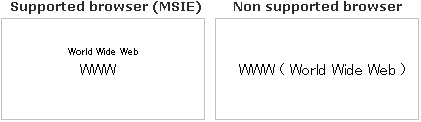
Example
<p>
Ruby example:
<ruby><rb>HTML</rb><rp>(</rp><rt>HyperText Markup Language</rt><rp>)</rp></ruby>
</p>
- Output
-
Ruby example:
HTML
<html>
<head>
<title>TAG index</title>

<style type="text/css">

ruby {
ruby-align: left;
}

rt {
font-size: 70%;
color: #cc0000;
}

rp {
font-size: 70%;
}

</style>

</head>
<body>

<p>
Ruby example:
<ruby><rb>HTML</rb><rp>(</rp><rt>HyperText Markup Language</rt><rp>)</rp></ruby>
</p>

</body>
</html>
- Output
-
Ruby example:
HTML